Paper BOLs slow down invoicing, disputes and retail chargebacks. This guide explains what electronic bill of lading software should do for a US trucking company, what to check before you buy, and how to roll it out without disrupting the operation.
Picture a Friday afternoon at a 40-truck carrier. A driver is back from a retail distribution center with the signed bill of lading folded in the door pocket of the cab. The receiver wrote "2 pallets short" next to the signature. Billing can't send the invoice until someone sees that note, and six weeks later the retailer issues a chargeback for the shortage. Now the office spends an afternoon looking for the one piece of paper that proves what was delivered. Electronic bill of lading software exists to remove that whole chain of waiting and searching: the BOL is created from the load, signed on the driver's phone, stored the moment it is signed and available to billing, dispatch and the customer at the same time.
This guide covers what an eBOL is, whether it is legally valid in the US, what to look for in electronic bill of lading software, and how to switch from paper without disrupting your operation.
If paper BOLs are the reason your invoices go out days after delivery, a short demo will show you a signed eBOL turning into an invoice the same day.
Need a bill of lading right now for a one-off load? Use Dashdoc's free bill of lading template to fill in a BOL and download it as a PDF.
What Is an Electronic Bill of Lading (eBOL)?
A bill of lading is the document a carrier issues when it takes freight from a shipper. It acts as a receipt for the goods, as evidence of the contract of carriage and, in some cases, as a document of title. On a typical domestic truckload or LTL move, it is a straight (non-negotiable) bill of lading: it names the shipper and consignee, the commodity, piece count and weight, special instructions and the signatures at pickup and delivery.
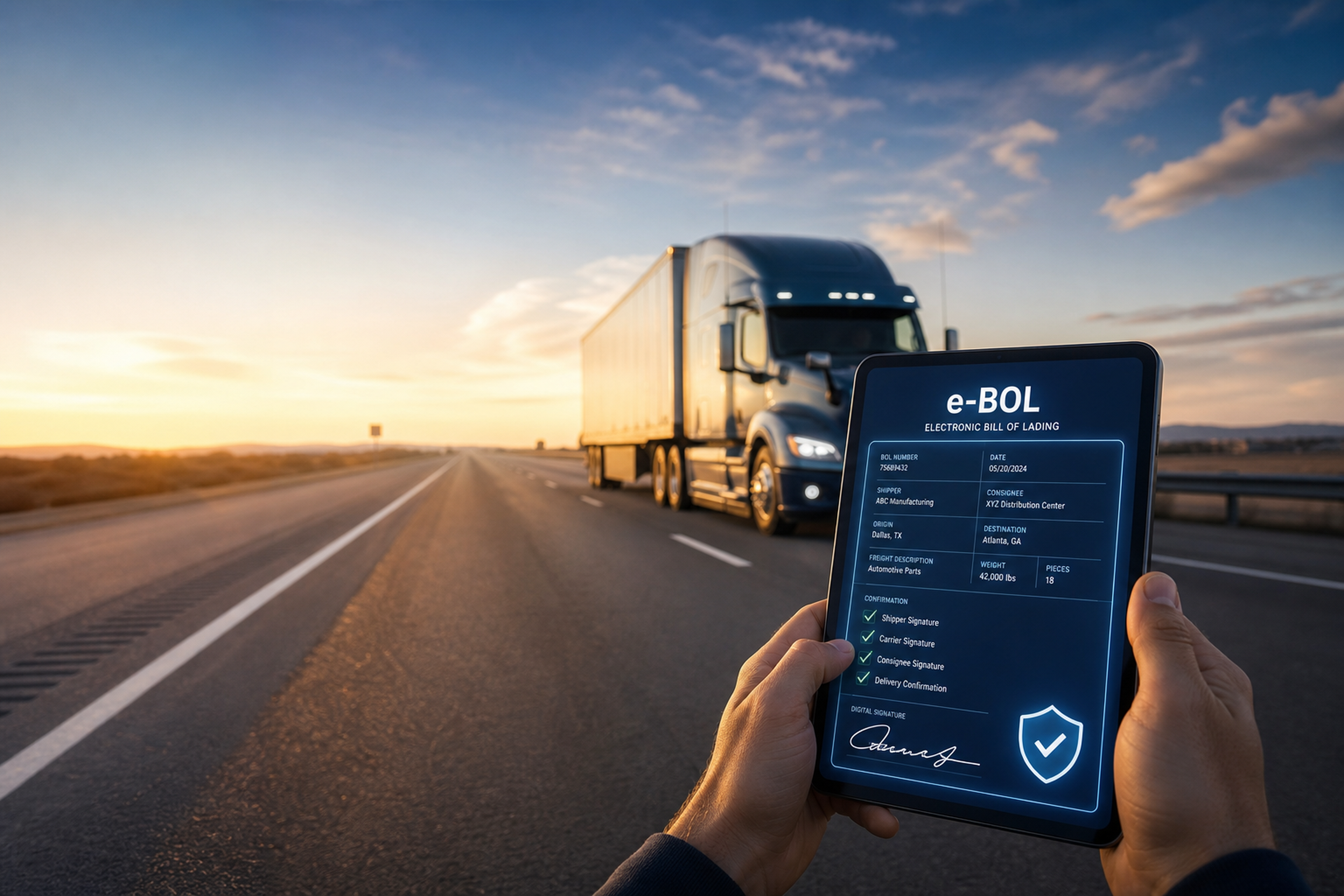
An electronic bill of lading (eBOL) carries the same information, but it is created, signed, shared and stored digitally. Instead of a carbon copy in the cab, every party in the shipment works from the same record: the shipper's dock, the driver, the carrier's back office and the receiver.
The US freight industry has been moving in this direction for several years. The NMFTA's Digital LTL Council published an eBOL standard in 2022 and asked LTL carriers to pledge adoption by July 20, 2023; its eBOL API standard is now at version 2.1. On the compliance side, an FMCSA final rule published in February 2026 (effective March 23, 2026) states explicitly that driver vehicle inspection reports can be completed electronically, another sign that regulators expect paperless records in trucking.
Trucking eBOL vs. ocean eBL: not the same thing
If you search for "electronic bill of lading", most results talk about ocean shipping. An ocean electronic bill of lading (often written eBL) is usually a negotiable document of title that can be transferred to sell or finance cargo at sea, which is why shipping lines and trade-finance platforms invest so much in it. A domestic trucking eBOL solves a different, more operational problem: proving what was picked up and delivered, and getting that proof to billing fast. When you evaluate software, make sure it was built for road freight and for the carrier's daily workflow.
Is an Electronic Bill of Lading Legally Valid in the US?
Yes. Electronic records and signatures are recognized for US commerce under the federal E-SIGN Act and under the Uniform Electronic Transactions Act (UETA), which 49 states and the District of Columbia have adopted. New York, the one state that did not adopt UETA, recognizes electronic signatures under its own Electronic Signatures and Records Act.
Two practical points still matter. First, some shippers and retailers set their own document rules in carrier agreements or vendor compliance manuals, so check what each customer expects. Second, a few freight types come with specific paperwork rules (household goods moves, for example, have a detailed list of required bill of lading items in 49 CFR 375.505). This is general information, not legal advice.
What Paper BOLs Really Cost a Trucking Company
Paper BOLs rarely show up as a line in the P&L. The cost is spread across dispatch, billing and the drivers, which is why most carriers underestimate it. Follow one load from the cab to the invoice and the leaks become visible:
Invoices wait for paper. Billing can't send the invoice until the signed BOL or proof of delivery comes back from the driver, by hand, photo, fax or at the end of the week.
Data gets typed twice. Weights, piece counts and references are copied from paper into the TMS and the accounting system, and every copy is a chance for an error.
Factoring needs the paperwork too. Carriers that factor their invoices usually have to send the signed BOL or POD with each invoice, so a missing page delays the cash.
Disputes turn into archaeology. When a customer questions a delivery, someone has to find the right piece of paper, read the handwriting and check whether an exception was noted.
Documents get lost. A damaged or missing BOL can hold up payment and leave you without proof when you need it most.
Retail chargebacks: find the signed BOL in seconds, not days
Retail freight adds one more risk. Large retailers apply chargebacks when a delivery is late, short or doesn't match the advance ship notice, and many of them ask suppliers for a VICS-format bill of lading. When a chargeback lands weeks after delivery, the shipper (or the carrier, if the claim comes back to it) needs two things quickly: the BOL that shows what the carrier picked up, and the delivery receipt signed by the receiver with the carton or pallet count and any exception noted. With paper, that often means digging through boxes. With an eBOL archive, it is a search by reference number.
What to Look For in Electronic Bill of Lading Software
Not every product sold as eBOL software changes the way your operation runs. Some only turn a paper form into a PDF. Use this checklist when you compare vendors.
1. The eBOL is created from the load, not retyped
The BOL should be generated from the shipment data already in the system (shipper, consignee, references, goods, weights). If someone still has to fill in a separate form, you have moved the paperwork, not removed it.
2. Signatures at pickup and delivery, with photos, time and location
The driver should capture the shipper's signature at pickup and the receiver's signature at delivery on a phone. Each signature should be stored with a timestamp and GPS location, and the driver should be able to add photos of the freight, seals or the trailer.
3. Exceptions recorded at the dock
Shortages, overages and damage need to be recorded at the moment of delivery, in the app, with photos and the receiver's signature next to the note. That record is what protects you in a claim or a chargeback.
4. Works without a signal
Docks, rural sites and big warehouses often have no coverage. The driver app must keep working offline and sync automatically when the connection comes back.
5. A searchable document archive
Every signed eBOL should be stored automatically and found in seconds by reference, date, customer, location or driver. Ask the vendor to show you a search during the demo, not just a list of files.
6. Customer access to documents
Shippers and 3PL customers increasingly want to see status and signed documents themselves instead of emailing your team for each POD. A customer portal that shows the load and its documents cuts that email traffic. See our guide to customer portal software for trucking companies for what customers expect.
7. A straight line from paperwork to invoice
This is where most of the value sits. When the delivery is confirmed and the eBOL is signed, the invoice should be ready to send, with the right rate and the documents attached. If your drivers also handle paperwork like rate confirmations and delivery receipts, check that those documents land on the same load. Our article on freight billing software for small carriers goes deeper on the billing side.
8. Standards and integrations you actually need
If you exchange eBOL data with large LTL networks by API, ask whether the vendor supports the NMFTA eBOL 2.1 standard (Dashdoc does not support it today; its eBOL is built into the carrier's own load workflow). If you work with an accounting system, a factoring company or customer EDI, ask exactly how documents and invoices flow to each one, and ask to see it working.
Bulk carriers have extra paperwork riding with every BOL, such as scale tickets and wash records. Our guide to bulk hauling software explains what to check when those documents need to reach the invoice too.
Paper BOL vs. eBOL: A Side-by-Side View
When billing can start: Paper: when the signed BOL comes back to the office. eBOL: as soon as delivery is confirmed in the app.
Proof in a dispute: Paper: a handwritten note, if it can be found. eBOL: signature, timestamp, GPS location and photos on one record.
Exceptions: Paper: written on the copy and often seen days later. eBOL: recorded at the dock and visible to the office right away.
Customer questions: Paper: emails and calls to dispatch. eBOL: the customer checks status and documents directly.
Document loss: Paper: real risk at every hand-off. eBOL: stored automatically when signed.
Audits and chargebacks: Paper: boxes and binders. eBOL: search by reference.
Where Dashdoc Fits: From the Driver's Phone to the Invoice
Dashdoc is a transportation management system built for carriers, and the eBOL is part of the load workflow rather than a separate document tool. Here is how it works in practice:
The eBOL is generated automatically from each load. Dispatch creates the load (or Dashdoc's AI order creation turns an incoming order into a load), assigns it to a driver, and the driver receives it in the driver mobile app.
Signatures, photos, timestamps and GPS at every step. The driver collects electronic signatures at pickup and delivery and can add photos, so each load carries its own proof of delivery.
The app keeps working offline. Drivers can sign and validate eBOLs without a signal, and the data syncs when the connection returns.
Documents are available in seconds. Signed documents are centralized and can be found by location, driver or reference, which is exactly what you need when a dispute or a chargeback arrives.
Customers see what they need. With the customer portal, shippers follow their loads and access documents without calling or emailing your team.
Invoicing starts when delivery is confirmed. Dashdoc's invoicing uses the load data and your tariff grids to build the invoice, so billing no longer waits for paper to come back.
You can see the full eBOL workflow on the Dashdoc eBOL page. In a demo, we walk through one load from creation to signed eBOL to invoice, using your own type of freight and your own documents.
Want to see a driver sign an eBOL on the phone and the invoice build itself from the load? Book a 30-minute demo and bring a real load from last week.
How to Switch From Paper BOLs to eBOLs Without Disrupting Operations
The technology is the easy part. The switch works when you plan it around people and customers:
Start with one customer or one lane. Pick a customer with regular loads and a receiving team you know. Prove the workflow there, then roll it out to the rest of your freight.
Tell receivers and shippers in advance. Most docks are used to signing on a driver's phone, but a short heads-up avoids friction on day one.
Agree on exception rules. Decide what drivers must photograph and note when freight is short, over or damaged, and train them on it before the first load.
Check your factoring company and big customers. Confirm the document format they accept and how they want to receive it.
Keep a paper backup for the first weeks. Have a fallback for the rare receiver who refuses to sign electronically, and track how often it happens.
If the eBOL is part of a wider move to a new TMS, our guide on how to switch TMS without disrupting your trucking operations covers the full project. And if lost or late PODs are already hurting your cash flow, read the true cost of lost PODs and our DSO benchmarks for trucking companies.
Key Takeaways
An eBOL is legally valid for US domestic freight under E-SIGN, UETA and New York's own law. Check each customer's document rules.
The value of electronic bill of lading software is not the digital file. It is the time it removes between delivery and invoice, and the proof it gives you in disputes and chargebacks.
Look for eBOLs created from the load, signatures with photos, time and GPS, exceptions recorded at the dock, offline mode, a searchable archive, customer access and a direct path to invoicing.
Roll it out one customer at a time, with clear exception rules for drivers.
If you want your BOLs signed, stored and invoiced without anyone chasing paper, book a demo and we will show you that flow on one of your own loads.
Frequently Asked Questions
Is an electronic bill of lading legally valid in the US?
Yes. The federal E-SIGN Act and the Uniform Electronic Transactions Act (adopted by 49 states and the District of Columbia) recognize electronic records and signatures, and New York recognizes them under its Electronic Signatures and Records Act. Some customers and some freight types (such as household goods) have their own document requirements, so check those before you switch.
What is the difference between an eBOL and a PDF bill of lading?
A PDF BOL still has to be printed, signed by hand, scanned and emailed, so most of the delays of paper remain. A true eBOL is created from the load, signed on a mobile device with a timestamp and location, stored automatically and shared with billing and the customer right away.
What happens if the receiver refuses to sign the eBOL?
The driver records the refusal in the app with photos and a note, which gives you a timestamped record of the situation. It is still worth keeping a simple paper fallback for the first weeks and agreeing in advance with key customers how refusals are handled.
Will my factoring company accept an electronic BOL?
Many factoring companies work with digital documents, but requirements vary. Ask yours which format it accepts and how it wants to receive signed BOLs and PODs, and choose software that lets you export or send the signed documents with each invoice.
Does electronic bill of lading software work for both LTL and truckload?
Yes, but the needs differ. Truckload is usually one pickup and one delivery, while LTL involves more stops, partial deliveries and, for large networks, API exchange based on the NMFTA eBOL standard. Dashdoc does not support the NMFTA eBOL 2.1 API today, so if that exchange is a requirement, plan for it separately. Check that the software handles your freight mix and the exchanges your customers require.